Mandala Art Fusion Techniques for Cross-Cultural Design
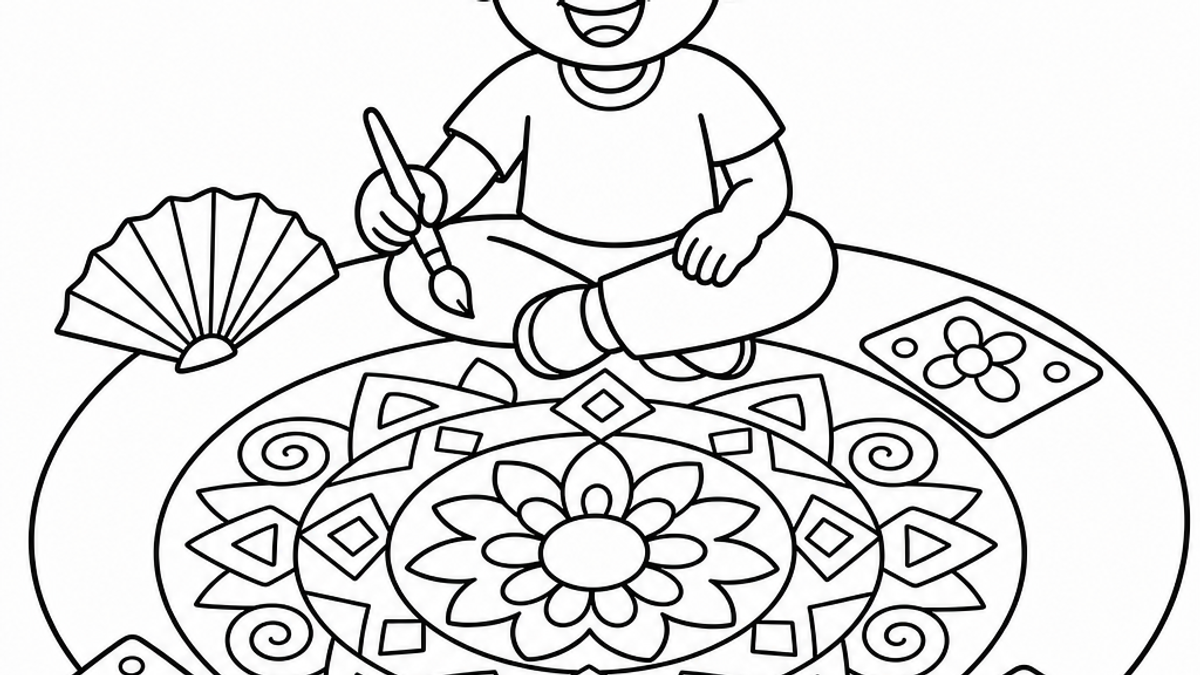
The first time we handed a mandala coloring page to a 6-year-old, she squinted at it and said it looked like "a snowflake had a baby with a pizza." Fair description, honestly. That's sort of the point of mandala geometric fusion pages: circles, triangles, and repeating shapes borrowed from a dozen traditions, all layered into one pattern a kid can fill in with crayons.
Mandalas show up in Buddhist sand art, Hindu temple carvings, Native American sand paintings, Islamic geometric tilework, and plenty of folk art traditions that never got a fancy museum label. A "fusion" mandala coloring page takes motifs from a few of these traditions and blends them into one design, simplified enough for small hands and short attention spans. It's less "authentic replica" and more "visual introduction," the kind of thing that gets a kid curious enough to ask a real question at dinner.
Cross-cultural mandala coloring pages for kids
A cross-cultural mandala page usually mixes a few recognizable elements: a lotus-petal ring from South Asian art, a radiating sunburst you'd see in Native American beadwork, maybe a tessellated border echoing Islamic tile patterns. None of it is meant to stand in for one specific culture's sacred practice. Think of it as a sampler plate, not a replacement for the real thing.
That distinction matters for teachers especially. If a page claims to "be" a specific nation's traditional mandala, that's a bigger claim than a coloring sheet can back up. The honest framing is "inspired by patterns found in multiple cultures," and that framing is also just more accurate.
Kids don't need the nuance spelled out in full. A simple line works fine: "This pattern borrows ideas from India, and this part borrows from a style used in parts of the Middle East." Repeating that over a few pages, across a few weeks, builds the vocabulary without a lecture.
Geometric mandala patterns for children to color
Under the cultural layer, a mandala is a geometry exercise wearing a costume. Circles divided into equal wedges, repeating triangles, symmetrical petals. The Getty Museum's elements of art guide describes geometric shapes as "mathematical, named shapes such as squares, rectangles, circles" and notes they're often man-made, used deliberately for structure and repetition. That's exactly what a mandala is doing on paper: line, shape, and color repeated around a center point.
For kids, that repetition is where the pattern recognition and symmetry learning sneaks in. Coloring the same shape the same color every time it repeats around the circle (without being told to) is a kid quietly noticing structure on their own. Some will group colors by instinct. Some will go rogue and make every petal a different color, which, fine, also teaches them something about intensity and contrast per the same Getty framework (hue, value, intensity are literally the vocabulary for "why does this one look brighter").
The fine motor piece matters too, though we'd rather undersell this than oversell it. The National Association for the Education of Young Children lists drawing, scribbling, and coloring with crayons alongside puzzles and playdough as activities that build hand and finger control, the same control kids will eventually need for writing with a pencil. It's one opportunity among many, not a guaranteed skill-builder on its own, and every kid develops at a different pace.
For kids who aren't ready for small, tight spaces yet, bigger, bolder shapes work better. Our bold and easy animal coloring pages use the same chunky-line logic before a kid graduates to tighter mandala detail.
Mandala coloring pages for cultural art projects
For a classroom or homeschool unit, mandalas are an easy slot-in because they don't require a trip to a museum or a supply order. Print, hand out crayons, done. A teacher we talked to said she keeps a folder of mandala variations by continent so she can match the page to whatever region the class is studying that week. Saves her from scrambling the night before.
A few project ideas that actually survive contact with a real classroom:
- Pair each mandala style with a one-paragraph fact card about where its motifs come from, read aloud before coloring starts.
- Have kids color the same blank mandala outline twice, once with "warm" colors and once with "cool" colors, then compare how different the same shape looks.
- Use mandalas as a five-minute settle-down activity right after recess, when the room needs to downshift before the next lesson.
That last one works for the same reason sensory-break coloring works generally: it's quiet, it's screen-free, and every kid can do it at their own pace without anyone finishing "first" or "last."
Mandala art activities for multicultural learning
The goal of a world cultures unit isn't to turn 7-year-olds into art historians. It's to plant the idea that different places have different ways of making beautiful things, and that's worth noticing. Geometric patterns are common across so many cultural art traditions partly because geometry doesn't need words. A repeating triangle means something similar whether it's carved into a mosque wall or woven into a textile on another continent entirely, which makes it a useful entry point for kids who aren't ready for heavier history yet.
We'd gently push back on any activity that promises a coloring page will "teach diversity" by itself. It won't, not alone. What it can do is give a kid a concrete, hands-on moment to pair with the actual conversation, the book, the video, the visit from a guest speaker. The coloring page is the hook, not the whole lesson.
Frequently asked questions
What is a mandala and why do different cultures use them?
A mandala is a circular design built from repeating shapes around a center point. Buddhist and Hindu traditions use them in meditation and ritual art, Islamic art uses related geometric repetition in tilework, and various folk traditions use circular symmetry in textiles and pottery. The shared thread is the circle and the repetition, used differently in each tradition.
How do I explain mandala patterns to my child?
Keep it concrete. "This is a circle cut into equal slices, like a pizza, and each slice has the same little picture in it" lands better with a 5-year-old than a history lecture. Save the cultural context for a short, separate conversation, maybe while they're already coloring.
Are mandala coloring pages good for kids with anxiety?
Many parents and teachers find repetitive, structured coloring calming for kids who are anxious, since it's quiet, screen-free, and doesn't require a right answer. That's a reported preference, not a guaranteed treatment, and anxiety varies a lot from kid to kid. If anxiety is a persistent concern, a pediatrician or therapist is the right first call. Our coloring pages for anxious children collection leans into that same calm, structured format.
What age is appropriate for mandala coloring pages?
Simplified mandalas with thick lines and big sections work for kids around 4 to 5. Finer, more detailed mandalas with small repeating petals suit kids 7 and up who have more patience and finer pencil control. There's no hard cutoff, it depends on the kid in front of you.
How can coloring mandalas teach kids about other cultures?
It gives a kid a physical object to connect to a place or tradition, which tends to stick better than a fact alone. Paired with a short explanation or a book, it becomes a memory hook rather than a throwaway worksheet.
Why are geometric patterns common in cultural art?
Geometric shapes are precise and repeatable by hand or by tool, which made them practical for textiles, tile, and carving long before rulers and computers existed. They also carry symbolic weight in many traditions, representing order, balance, or the structure of the universe depending on the culture.
How long does it take a child to color a mandala page?
Anywhere from ten minutes to the better part of an hour, depending on detail level and the kid's patience that day. Simpler mandalas finish fast. Detailed ones can become a whole quiet-afternoon project, which, depending on your week, might be exactly what you need.
Where can I find free printable mandala coloring pages for kids?
Chunky Crayon publishes a new free coloring page every day at 8am UTC, no account needed, and the first two custom pages you generate are also free. If a kid wants a mandala mixing, say, dinosaur shapes with geometric petals (yes, we get requests like that), typing the idea in gets a printable page in about two minutes.
If your kid's current obsession doesn't fit neatly into "mandala," our cute dinosaur coloring pages are a solid screen-free backup for the days geometry isn't the mood.
The Chunky Crayon Editorial Team
Chunky Crayon editorial
The Chunky Crayon team publishes playful, practical and source-aware ideas for creative family time. Developmental or wellbeing claims are general education, not clinical or educational assessment.