Celestial Phenomena Coloring Pages for Astronomy Lovers
By The Chunky Crayon Editorial Team
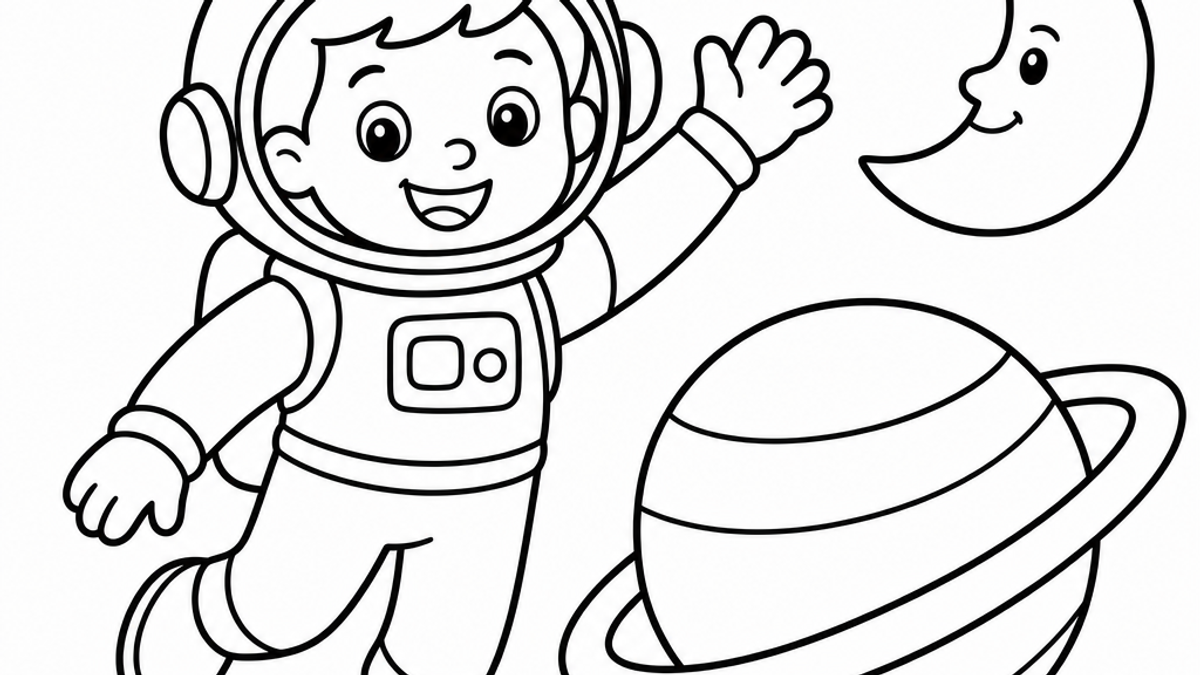
Somewhere around bedtime, every kid asks the big questions. Why does the moon change shape? What's a black hole, actually? Could we live on Mars? You can answer with a diagram, or you can hand them a crayon and a picture of Saturn's rings and let the questions keep coming while their hands stay busy. We've found the second one buys you about twenty more minutes before lights-out.
Celestial phenomena coloring pages sit at a nice intersection: kids who are obsessed with space get a reason to sit still, and parents get a screen-free activity that doesn't feel like homework. Here's how to use the whole category, from preschooler-friendly planets to the trickier stuff like supernovas and black holes.
Space is one of the few subjects that's genuinely interesting at every age. A 3-year-old likes a smiling rocket ship. An 8-year-old wants to know if Jupiter's red spot is actually a storm bigger than Earth (it is). Astronomy coloring pages for kids scale with that curiosity instead of outgrowing it in a season, the way some licensed-character pages do.
For the youngest group, outer space coloring sheets for preschoolers work best when they're simple: a round planet, a few stars, a friendly alien with big eyes. Thick outlines, minimal detail, nothing that requires patience they don't have yet. A printable astronomy coloring book for kids that spans ages (some pages bold and simple, some with more detail) saves you from buying three separate books as your child grows into the subject.
We'll admit the category has a built-in problem: space is mostly black, which to a 4-year-old reads as "boring color, skip it." The workaround is simple. Let the sky be whatever color they want. Purple nebulae, pink stars, a green moon. Astronomy doesn't actually require accuracy from a 5-year-old with a crayon box.
These are the "I saw it on the news" phenomena, and they're great coloring subjects because kids have usually already seen a photo and have opinions about what it should look like.
Solar eclipse coloring pages for kids usually show the sun as a black circle with a bright ring, the famous "diamond ring" moment. It's a satisfying shape to color: bold, high contrast, easy for small hands to fill in without staying inside tiny lines.
Meteor shower coloring pages printable well tend to have several streaking lines across a dark sky. This is a good spot to talk about speed and direction with your kid while they color, since the lines all point one way. It's a small, accidental geometry lesson.
Northern lights and aurora borealis coloring pages for children are the most forgiving pages in the whole category, because the real aurora comes in sweeping ribbons of green, pink, and purple. There's no wrong color choice. If your kid wants an orange aurora, nature occasionally agrees with them anyway.
Galaxy coloring pages printable free versions usually show a spiral shape, swirling arms, a bright center. These pages are oddly good for slightly older kids who've started asking about scale: how big the universe is, how many stars there might be, whether anyone else is out there. Big questions, small crayon.
Planets and stars coloring pages printable sets are the bread and butter of this whole category. Saturn's rings, Jupiter's bands, Mars in rust red. If your child has a favorite planet this month (ours currently informally tracks a lot of Saturn requests, probably because rings are fun to draw), a page built around just that planet holds attention longer than a generic "solar system" page with eight planets crammed onto one sheet.
Color choices here are genuinely open-ended, which the J. Paul Getty Museum's guide to the elements of art describes well: color has hue, value, and intensity, and none of those have one correct answer. A dull, muted Mars and a bright, intense Mars are both valid choices, not a mistake to correct.
This is where coloring pages double as a light science lesson, if you want them to.
Constellation coloring pages for kids usually connect dots or stars with faint lines into shapes like the Big Dipper or Orion's belt. The easiest way to teach constellations with a coloring page: color the stars first, then have your kid trace the connecting lines with a finger before picking up a pencil to draw them in. It turns an abstract concept ("stars that make shapes") into something their hand has actually traced.
Lunar phases coloring pages for kids typically show the moon in a row, from new moon through full moon and back. Coloring each phase in order is a decent way to explain why the moon looks different throughout the month without pulling up a diagram on a screen. Kids remember the sequence better when their hand did something with it, not just their eyes.
If you want to go further, a bedtime routine built around the current moon phase (step outside, look up, then color that phase inside) turns a coloring page into a small ritual rather than a one-off worksheet. For the gap between "coloring sheet" and "actual night sky," our easy space coloring pages for kids collection has enough variety that you can usually match a page to whatever your kid just saw outside.
Some space topics only click once a kid is a little older, usually around 6 to 8, and that's fine. Comet coloring pages for children show a bright nucleus with a long glowing tail, good for talking about ice, dust, and orbit without getting too technical.
Black hole coloring pages for kids are consistently a hit with the slightly-too-interested-in-dark-things crowd (no judgment, we had that kid too). A black hole page usually shows a dark circle surrounded by a glowing ring of matter being pulled in, which is close enough to the real physics for a 7-year-old's purposes.
Supernova coloring pages for kids show a star's explosion as a burst of radiating color, which makes them some of the most satisfying pages in the whole set to fill in. Big bold strokes, high contrast, zero pressure to stay delicate about it. If your kid likes going hard with the crayon, this is their page.
We won't claim a coloring page teaches astronomy on its own, or that it fixes screen time battles. What we can say: coloring is one of the activities NAEYC lists among those that build fine motor control, the small hand and finger movements kids later use for writing and other tasks. Individual kids develop these skills at different rates, and one coloring session isn't going to change that timeline. It's just a reasonable way to spend the practice time.
On the screen-free side, the American Academy of Pediatrics' guidance on family media plans suggests building in screen-free zones and swapping in other activities so screens don't crowd out everything else. A stack of space pages by the door works as exactly that kind of swap for the after-school or rainy-afternoon slot, alongside other rainy day coloring activities you've probably already got in rotation.
Space has built-in variety (planets, moons, explosions, dark skies) and no "correct" color scheme, which gives kids a lot of freedom. It also connects to something they're already curious about, which usually holds attention longer than a page with no story behind it.
Have them color the stars first, trace the shape with a finger, then draw the connecting lines. Naming the shape out loud while they work ("this one's the Big Dipper, it looks like a spoon") helps it stick.
The category works from toddler through early elementary. Preschoolers do best with simple, bold shapes like a single planet or a smiling rocket. Kids 6 and up can handle more detailed pages like constellations, black holes, or full solar system scenes.
It gives them a reason to sit with a topic longer than a quick explanation would, and it's a chance to ask questions while their hands are occupied. It's a supplement to learning, not a replacement for a book, a planetarium visit, or an actual night spent looking up.
Yes, plenty of sites including ours offer free printable planet and galaxy pages. Our daily picture, posted free every morning, has featured space themes before, and our easy space coloring pages for kids page has a standing set you can print anytime.
There's no fixed rule. Watch your kid, not the clock. Most preschoolers naturally wander off after 10 to 15 minutes, while an older kid deep into a detailed galaxy page might happily go for 30.
Keep it simple and physical. Point at the moon on a walk, say "that's the moon," then later hand them a page with a big round moon to color. Toddlers learn through repetition and touch more than explanation, so the coloring page reinforces what they already saw outside.
If your kid has moved on from generic planets to something very specific, like "a comet wearing a hat" (we've seen weirder requests), our generator lets you type or say what you want and get a printable page in about two minutes.
Chunky Crayon editorial
The Chunky Crayon team publishes playful, practical and source-aware ideas for creative family time. Developmental or wellbeing claims are general education, not clinical or educational assessment.