Space Debris Coloring Pages for Environmental Awareness
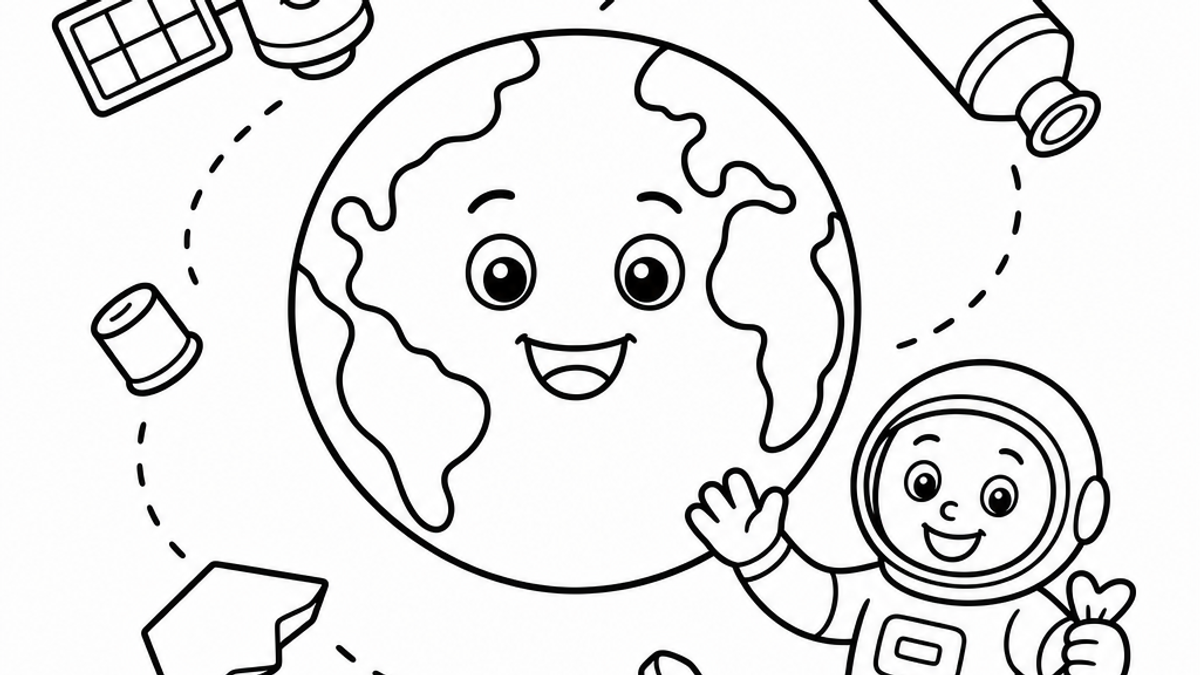
A kid spots a shooting star, gets excited, and then asks the one question that ruins stargazing forever: "Is that a real star or is that space trash?" Fair question. These days it's often the second one. Somewhere above our heads right now, dead satellites, spent rocket stages, and stray bolts are circling the planet, and most of it never gets explained to the people who ask the best questions about it: kids.
Space debris coloring pages are a weirdly good way to answer that question. Not because a crayon fixes orbital pollution (it doesn't, obviously), but because coloring slows a kid down long enough to actually look at a satellite, a rocket stage, and a trail of junk and ask what each piece is doing up there. That's the whole job of this post: how to use space debris coloring pages to explain a genuinely confusing environmental topic without losing a 6-year-old by paragraph two.
What Space Debris Actually Is (and How to Explain It Without Losing Them)
Space debris is just old stuff that never came home. Dead satellites that ran out of battery. The top half of a rocket that did its job and got left behind. A glove an astronaut dropped decades ago that's still up there, technically in orbit, technically debris.
For a kid, the simplest version is: it's litter, but really far away and really fast. That second part matters. A paint fleck moving at orbital speed can chip a window on the International Space Station. Size isn't the scary part. Speed is.
We'd skip the full physics lecture for anyone under 8. "Old satellites that broke and never came down, plus parts of rockets that got left behind" covers it. Save the orbital velocity numbers for the kid who's already drawing diagrams of black holes on the back of their homework (every classroom has one).
Space Junk Coloring Pages for Kids: Why a Crayon Beats a Diagram
A labeled diagram of low Earth orbit is accurate. It is also the kind of thing that makes a 5-year-old's eyes glaze over before you finish the sentence "geostationary." A coloring page does the same job with less homework energy.
Put a simplified Earth in the center, a ring of satellites and debris specks around it, and let a kid pick the colors. That's it. That's the whole lesson delivery mechanism. The simplified version of line, shape, and color that artists have used forever to organize a messy scene actually has a name in art education: line defines the edges of a form, and color carries mood and emphasis on a page, which is exactly why a thick black line around a "good" satellite and a scribbly, chaotic line around a "junk" cluster reads instantly, even to a kid who can't read yet (Getty Museum Education). Kids don't need the vocabulary. They just need the visual contrast, and coloring hands it to them for free.
If your kid is deep into their space phase this month (every kid has one, right after dinosaurs and right before sharks), our space coloring pages for kids are a good low-pressure entry point before you get into the debris-specific stuff.
Satellite Debris Coloring Printable: From Launch to Graveyard Orbit
Here's a sequence that works well on paper: launch, working satellite, satellite dies, satellite becomes junk. Four small scenes, four crayons, one story a kid can actually follow start to finish.
Satellite Graveyard Coloring Page Printable
The "graveyard orbit" is real terminology, and kids love it precisely because it sounds a little spooky. It's the far-out orbit where engineers deliberately park dead satellites so they don't collide with working ones. A coloring page showing a ring of retired, faded-out satellites parked past the busy zone makes the idea of "we put our trash somewhere specific" click in a way that's hard to get across verbally.
(We will admit: we once had an early sketch of a satellite graveyard that looked less "solemn retirement home for machines" and more "something out of a horror movie." We toned down the cobwebs.)
STEM Coloring Pages About Space Debris in the Classroom
Teachers and childminders, this is the section for you. Space debris sits at a nice intersection: it's science, it's environmental education, and it's genuinely interesting to kids who otherwise glaze over at "pollution" as a topic because they've heard it a hundred times about oceans and never once about outer space.
Printable Space Debris Activity Sheets for School Projects
A strong classroom sheet does three things at once: shows what debris looks like (a cluster of specks, not one dramatic chunk), shows scale (Earth is small in the picture, the junk field is wide), and leaves blank space for a kid to add their own satellite design. That last part turns a worksheet into a project, which is the difference between five minutes of engagement and fifteen.
Coloring also happens to be one of the activities that gives kids repeated practice gripping a crayon, controlling pressure, and staying inside a boundary, the same small-muscle coordination used for buttoning a coat or holding a fork (NAEYC). That's a fine motor bonus, not a headline outcome. It's not why you'd assign the worksheet, but it's not nothing either.
If you run a classroom quiet corner or an OT setup where kids do independent seatwork, our occupational therapy coloring sheets pair well with science units like this one.
Space Cleanup Coloring Pages for Kids: What They Can Actually Do
Here's where a lot of environmental lessons go sideways with little kids: the problem is huge, the kid is small, and the gap between those two facts can either motivate or completely deflate them. Keep it concrete.
Kids can't launch a debris-collecting satellite. They can:
- Pick up litter on the ground, which is the same "someone has to clean up what gets left behind" idea, just closer to home.
- Ask questions about where things end up, on Earth or in orbit, which keeps curiosity open instead of closing it with doom.
- Draw their own idea for a cleanup tool, a net, a magnet, a claw, whatever a 6-year-old's imagination produces. Some of the real engineering concepts being tested right now (nets, harpoons, drag sails) aren't far off from what a kid draws unprompted, which is a fun thing to point out.
A coloring page with a half-finished cleanup scene, a little robot satellite catching debris in a net, gives kids something hopeful to finish instead of leaving them staring at a cluttered sky with no fix in sight.
FAQ: Space Debris Coloring Pages, Answered Plainly
What is space debris and how do you explain it to kids?
It's old space stuff, dead satellites, leftover rocket parts, that never came back down and is still circling Earth. For young kids, "space litter that moves really fast" is enough.
Why is space junk a problem for the environment?
It can collide with working satellites (weather, GPS, communications) and create even more debris. It's also a growing orbital pollution problem that future missions will have to navigate around.
How can coloring pages teach kids about space pollution?
They turn an abstract, invisible problem into something a kid can see, sort by color, and talk about while their hands are busy. That's a low-pressure way in, not a substitute for the fuller conversation.
What age is space debris coloring appropriate for?
Simplified versions (Earth, satellites, a few debris specks) work from about age 4. More detailed orbital diagrams and graveyard-orbit concepts land better from age 7 or 8 up.
How do satellites become space junk?
They run out of fuel or power, stop responding to control signals, and stay in orbit with no way to move themselves out of the way.
Are there printable worksheets about space debris for school projects?
Yes, and pairing a coloring sheet with a short writing or labeling task turns it into a full science worksheet rather than just an activity page.
How does space debris affect Earth?
Most debris burns up harmlessly in the atmosphere on reentry. The bigger concern is collisions in orbit that threaten satellites we rely on for weather forecasts, GPS, and communication.
What can kids do to help reduce space pollution?
Not much directly, and that's okay to say out loud. The honest answer is curiosity now (asking questions, following space cleanup news) builds the adults who might actually work on this later.
One more thing worth saying plainly, since we're on the topic of kids and screens: a coloring page about space debris works well as a screen-free wind-down after a video about satellites, not a replacement for every form of learning. Families setting up their own routines around screen time versus hands-on activities might find the AAP's guidance on family media plans useful for figuring out where something like this fits.
If your kid wants a coloring page of their own cleanup satellite idea, something our premade sheets won't cover, our generator can turn "a robot with a big net catching space junk" into a printable page in about two minutes.
The Chunky Crayon Editorial Team
Chunky Crayon editorial
The Chunky Crayon team publishes playful, practical and source-aware ideas for creative family time. Developmental or wellbeing claims are general education, not clinical or educational assessment.