Coffee Flavor Chemistry Coloring Pages for Science Fun
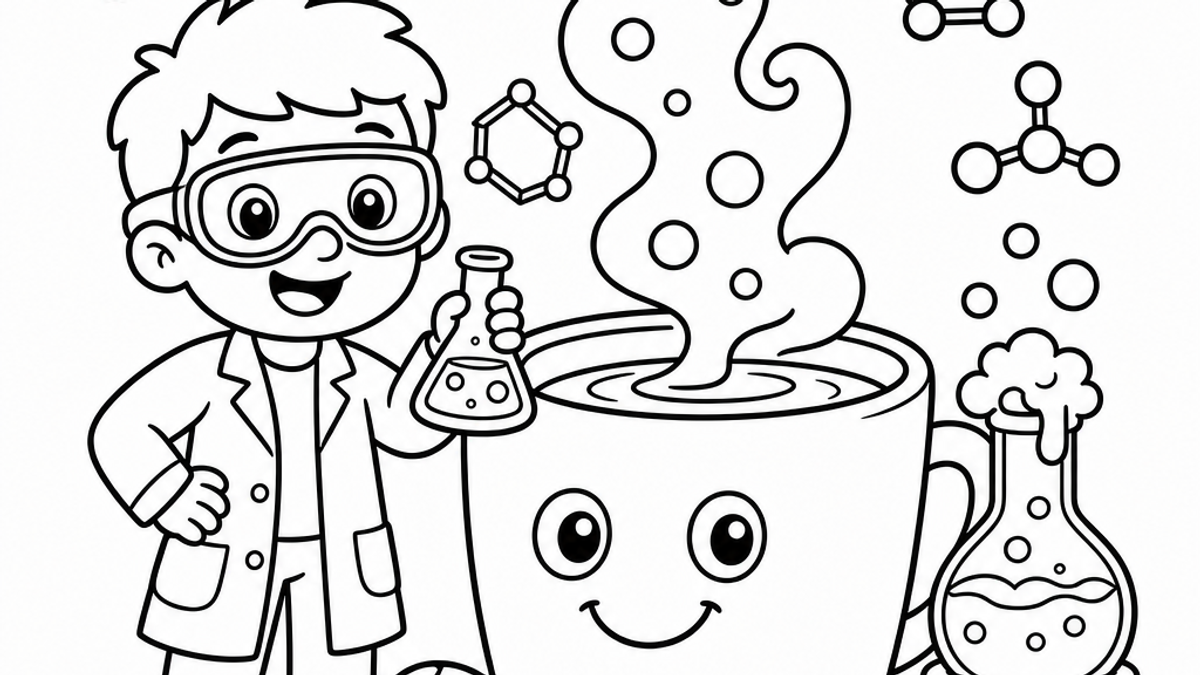
National Coffee Day Flavor Chemistry Coloring for Science Connection
September 29 is National Coffee Day, which in most households means a grown-up gets a slightly nicer coffee than usual and nobody under age ten cares even a little. That's fine. The coffee itself isn't the hook. The chemistry behind it is, and it turns out a coffee bean is one of the easiest ways to sneak real science into a kid's afternoon without opening a textbook.
Coffee beans change color when they're roasted. Coffee smells like one thing and tastes like a slightly different thing. Coffee can turn a liquid from clear to dark brown in minutes. All of that is chemistry a 5 to 9 year old can actually follow, and all of it pairs well with a crayon and a printed page.
Coffee Bean Coloring Pages for Science Class
Start with the bean itself. A coffee bean is a seed. It grows inside a red fruit called a coffee cherry, gets picked, gets dried, and then gets roasted. That's already four steps a kid can narrate while coloring a page showing the cherry-to-bean journey.
A simple science-class version looks like this:
- Draw or color the coffee cherry (red, round, a little shiny)
- Draw the green raw bean inside it
- Draw the roasted brown bean next to it
- Label each stage, even with invented kid-spelling
This is the part teachers and childminders tend to like best, because it's cross curricular learning without extra planning. It's art class, science class, and a vocabulary lesson about where food comes from, all on one printed sheet. One childminder told us she rotates pages by whatever the class is studying that week, coffee beans for a food unit, bugs for a nature walk, whatever keeps the questions coming.
Coffee Roasting Science for Kids Coloring
Here's the part that actually earns the word "chemistry." Raw, unroasted coffee beans are pale green. As they roast, heat triggers a chemical reaction called the Maillard reaction, the same reaction that browns toast and seared meat. Sugars and proteins in the bean react and the bean darkens, step by step, from green to yellow to light brown to dark brown to nearly black if you leave it too long.
That's a value scale. In art terms, value just means how light or dark a color is, and artists use a light-to-dark value scale all the time to show depth or mood, the same idea the Getty Museum's elements of art guide uses to explain how dark and light colors in a painting change what a viewer feels. A coffee roast chart is basically a value scale a kid can color in, light roast on one end, dark roast on the other, same bean, same chemical reaction, different amount of heat and time.
For a hands-on version:
- Print a row of five blank beans
- Color the first one pale yellow-green (raw)
- Color the last one almost black (dark roast)
- Fill the middle three in gradually, explaining out loud what's changing (heat, time, color, eventually flavor)
Kids who aren't ready to blend shades smoothly can tap-and-fill instead, which is exactly the kind of job our Magic Brush tool was built for. It's the easy mode for a kid who understands the concept of "getting darker" long before their hand can control a gradient.
Flavor Chemistry Coloring Pages: Taste and Smell Science
Here's a weird fact that tends to land well with the 6 and up crowd: a lot of what we call "taste" is actually smell. Your tongue only picks up a handful of basic tastes (sweet, salty, sour, bitter, savory). The rest, the stuff that makes coffee smell like coffee, chocolate, or caramel, comes from aroma compounds that travel up the back of your throat into your nose while you're drinking.
This explains a question we hear a lot from parents: why do kids like coffee smell but not the taste. The smell hits sweet, warm, roasty aroma receptors. The taste hits bitterness receptors, and kids are generally more sensitive to bitter flavors than adults are. Nobody's doing anything wrong here. A kid who loves sniffing a coffee bag and hates sipping the coffee is responding completely logically, just to two different parts of the same cup.
A flavor chemistry coloring page can show this split directly: a nose on one side picking up swirly "aroma lines" drifting up from the mug, a tongue on the other side with the basic tastes labeled. Kids color the aroma lines warm colors (brown, orange, gold) and the taste zones whatever colors feel right to them. There's no wrong answer here, which, frankly, is the best kind of science activity to run on a Tuesday afternoon.
This is also a nice entry point into taste and smell science coloring pages more broadly, since the same nose-and-tongue setup works for any food a kid already has opinions about. Pizza. Watermelon. The suspicious casserole from dinner last Tuesday.
Kitchen Science Coloring Activities Beyond Coffee Day
National Coffee Day is a good excuse, but the format holds up for any kitchen chemistry experiment. Food science for elementary kids works best when there's a real, visible change to observe: dough rising, an egg white turning foamy, ice melting into water, coffee turning a mug of milk tan.
A simple before-and-after coloring template turns any kitchen moment into a mini science fair project idea:
- One box for "before" (raw, cold, clear, whatever applies)
- One box for "after" (cooked, warm, changed color)
- A line connecting them labeled with the cause (heat, time, mixing)
This kind of sensory science play, noticing, naming, and then recording what changed, builds observation skills before kids have the vocabulary for formal lab reports. It also happens to be a solid screen-free afternoon activity, the kind the American Academy of Pediatrics suggests building into a family's regular routine rather than treating as a one-off substitute for a tablet, as outlined in their guide to family media plans.
There's a quieter benefit too. Coloring in those boxes, whether with careful strokes or an enthusiastic scribble, is also just hand practice. The National Association for the Education of Young Children lists coloring with crayons, markers, and pencils among the everyday activities that give kids a chance to build fine motor control, the same small-muscle skills they'll use for buttons, zippers, and eventually handwriting. We won't claim a coloring page builds anyone's pincer grip on its own, every kid develops at their own pace, but it's one more reason the crayon box earns its spot on the kitchen table during a science activity.
If a classroom wants a quieter stretch between the experiment and the explanation, a stack of these pages works well as a quiet classroom coloring activity while everyone's waiting for the dough to rise or the coffee to cool.
FAQ: Flavor Chemistry Coloring for Kids
Why does coffee taste different when roasted?
Heat triggers the Maillard reaction, breaking down sugars and proteins inside the bean and creating new flavor compounds. Longer, hotter roasts create darker beans and more bitter, smokier flavors; shorter roasts stay lighter and brighter.
How do you explain flavor chemistry to kids?
Start with something they can see change, like bean color during roasting, rather than something they can only taste. Visible change is easier for young kids to connect to cause and effect than flavor alone.
What is the science behind coffee flavor?
It's a mix of roasting chemistry (the Maillard reaction and caramelization) and sensory science, since most of what we perceive as flavor is actually aroma detected through the nose, not taste on the tongue.
How can coloring pages teach kids about chemistry?
They give kids a way to record a process, like a bean going from green to brown, step by step, which reinforces sequence and cause and effect without requiring reading or writing.
What is a fun science activity for National Coffee Day?
Coloring a roast-stage chart, drawing the cherry-to-bean-to-cup journey, or mapping where smell versus taste happens are all low-mess options that work for a classroom or a kitchen table.
How do you make chemistry fun for elementary kids?
Pick changes they can watch happen in real time (color, texture, smell) and give them a simple way to record what they noticed, whether that's a coloring page, a sentence, or both.
What age can kids understand basic food science?
Most kids can grasp simple cause-and-effect food science, like "heat makes this change color", by age 5 or 6, though every child's pace with abstract ideas like chemical reactions varies.
National Coffee Day only comes around once a year, but a stack of these pages works for any kitchen experiment your family or classroom tries next. If you want one built around whatever your kid is currently obsessed with (we've made pages for weirder requests than a coffee bean), our generator turns a description into a printable page in about two minutes.
The Chunky Crayon Editorial Team
Chunky Crayon editorial
The Chunky Crayon team publishes playful, practical and source-aware ideas for creative family time. Developmental or wellbeing claims are general education, not clinical or educational assessment.